
DEDDIE remote control, solved — at the lowest possible cost.
GPweb-Remote is the DEDDIE remote-control outstation for Greek PV plants, installed in your substation.
Tested and approved by DEDDIE's own operations team, and it runs the compliance tests itself — remotely, with the protocols written for you.
Talk to us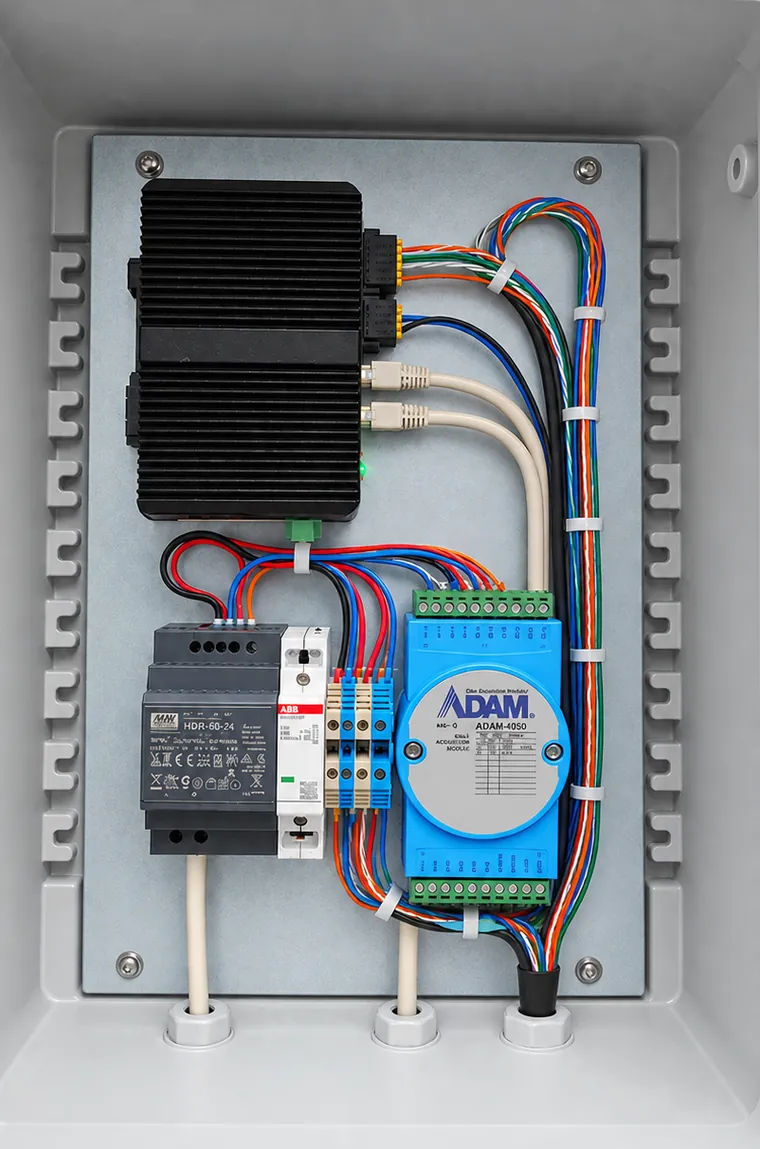
What DEDDIE requires, and of whom
What is required is not only a monitoring feed. The operator sends real commands — curtail to a percentage, cap at a kW figure, shut the plant down, release it — and expects the plant to obey, to confirm, and to go on obeying when the link goes quiet.
One box, the whole plant
GPweb-Remote is the single thing DEDDIE talks to. It speaks upstream to the DEDDIE and downstream to your equipment with whatever protocol is needed — the inverters and the MV protection relay — so there is no protocol converter in the cabinet and no second vendor in the project.
It also handles the parts nobody enjoys. When the link goes quiet, the last valid setpoint holds. We record which command, at what time, in which mode. "Why didn't you respond on the 14th?" is answered with a timestamped line instead of an argument.
Nobody has to be on site
Commissioning a plant for DEDDIE remote control has meant a technician on site for a day or two, stepping through the sequence by hand and writing up the protocols. GPweb does it instead automatically.
GPweb runs DEDDIE's own test sequence — the percentage sequence, the kW sequence, the command-priority matrix, shutdown and release, full park and half park — each held for the dwell time the specification asks for, recording its own measurements at every step. It then writes the protocols: in DEDDIE's own protocol forms. All you have to do is to submit the forms.
The official acceptance test with DEDDIE runs the same way: from afar. Being able to demonstrate the plant without anyone standing in the substation is the point.
What are your profits — and what was lost
Most monitoring tells you something went wrong. That is the easy half, and on its own it is a list of alarms nobody reads twice. The half that decides whether a plant is a good business is what the fault cost you.
So, the evaluation runs continuously: production measured against what the plant should have made, and the gap given a value. Every loss is attributed to a cause — a curtailment instruction from the operator, an inverter fault, a string that has been quietly underperforming since spring. Not an event log. A smart diagnostic tool.
That is a commercial instrument before it is anything else. You can see which losses are worth fixing, which belong to someone else, and how the plant is performing against the numbers it was financed on.
It also answers the DEDDIE question, without you having to ask it separately. Curtailment is capped — at around five per cent of production, counted in the value of the energy rather than the hours it lasted — and if nobody is valuing it, nobody can tell whether the cap held. We value it, with the working behind the figure, in a report that stands up if it is ever needed.
Built to be very hard to breach
This is grid infrastructure. A controller that can curtail a plant must be protected. Open ports on the internet, simple logins are not good enough protection from intruders. We designed the attack surface away instead of defending it.
The plant has no open ports. Not one. Every connection is made outward, so there is nothing listening for anyone to find — scan the site from the internet and no service answers.
All our devices are only reachable over a VPN tunnel. This is protection end to end, with its own key per device. Peers authenticate the server by its key, so a redirected endpoint cannot complete a handshake. Plants cannot reach one another. This means even a physical breach at one site does not and cannot compromise other sites.
Security in this market is usually sold as a certificate number in a brochure. Our security is in the design, layer by layer: nothing to find, nothing to answer. Getting in is meant to be very hard work, because it needs to be very well protected.
Whatever is in your plant
We support any equipment that is already there. We have drivers for all common inverters like Huawei, Sungrow, SMA, GoodWe, ABB/FIMER, Fronius, SolarEdge, any other SunSpec-compliant inverter, etc. GPweb needs to speak to the sub-station for MV control and measurement as well. Again we have drivers for all common manufacturers like Schneider Sepam, Siemens Reyrolle — actually anything that speaks Modbus — and we have a digital I/O driver for the parts that don't.
And when something is not on that list: if it speaks a documented protocol and we can get to one unit to test against, we write the driver for it — at no charge — and we prove it on your plant at commissioning. So far, we have not met one we could not do.
Common questions
Are you certified or approved by DEDDIE?
GPweb has been "tested and approved" by DEDDIE.
DEDDIE's operations team tested GPweb systems live, against simulated faults, over several hours, and confirmed it does everything it needs to do correctly. What matters for you is passing DEDDIE's on-site test. We have done this with our systems already = tested and approved.
There is no DEDDIE certification scheme to be certified under, and no approved-vendor list to be on. DEDDIE states on its own website that it does not recommend or verify the suitability of equipment from any manufacturer, and that equipment selection is the producer's responsibility.
Why not just use the datalogger that came with my inverters?
Because it is built for a different job. Inverter dataloggers exist only to monitor their manufacturer's own products. The DEDDIE remote control is an operator-facing interface: it has to accept DEDDIE's commands, confirm them the way they expect, arbitrate between conflicting ones, and behave correctly when the link drops.
Also DEDDIE needs measurement data from the MV side. The inverter datalogger cannot provide this data, and manufacturers rarely claim their logger does.
So the simple answer is: no, the datalogger cannot do what is required at all.
What happens if the link to DEDDIE drops?
The plant neither goes rogue nor goes dark. The last valid setpoint holds, so the plant stays inside the limit the operator last set.
And commands that must not be executed — the plant is in local for maintenance, say — are refused per the specification and recorded, not silently ignored.
All this is defined in DEDDIE's protocol specification and we have fully implemented it.
Which equipment do you support?
We support any equipment that is already there. We have drivers for all common inverters like Huawei, Sungrow, SMA, GoodWe, ABB/FIMER, Fronius, SolarEdge, any other SunSpec-compliant inverter, etc. GPweb needs to speak to the sub-station for MV control and measurement as well. Again we have drivers for all common manufacturers like Schneider Sepam, Siemens Reyrolle — actually anything that speaks Modbus — and we have a digital I/O driver for the parts that don't.
And when something is not on that list: if it speaks a documented protocol and we can get to one unit to test against, we write the driver for it — at no charge — and we prove it on your plant at commissioning. So far, we have not met one we could not do.
How do you connect to the plant, and what does that open up?
Nothing is opened. The controller dials out over VPN and holds the tunnel; there is no inbound port at the plant, no port forwarding on the site router, and no service exposed to the internet for anyone to find.
Each device has its own key. Our VPN server stores only public keys, so it can route to a plant but cannot log in to one — and plant-to-plant traffic is refused outright, which means one compromised site cannot become a route into the rest of the fleet.
Access is per person and revocable centrally.
What happens when DEDDIE changes the specification?
It has changed before and will change again, and inverter firmware moves underneath you as well. Following it is our job, not yours: drivers update in place, so a change at DEDDIE's end or at your inverter manufacturer's does not mean a new box or a site visit.
We simply provide updates to the software in GPweb-Remote to support whatever has to change.
How does this reach my project?
Through the people building the plant. Substation manufacturers bundle GPweb-Remote into the cabinet they are already building, so the substation ships DEDDIE-ready and the plant owner never runs a separate integration project. EPCs standardize on it across projects instead of rebuilding the operator interface every time.
Tell us about the plant — the inverters, the relay, the connection date. We will tell you what it takes, and how the acceptance test runs.
Contact us